The F4U Corsair is one of the most iconic fighter aircraft of the 20th century. Developed during World War II, this powerful warbird played a pivotal role in both the Pacific Theater and later, the Korean War.
From the moment it entered combat, the F4U Corsair demonstrated superior speed, agility, and firepower. Pilots who flew it revered its performance, especially in dogfights against Japanese aircraft. Ground crews praised its ruggedness and reliability in harsh conditions.
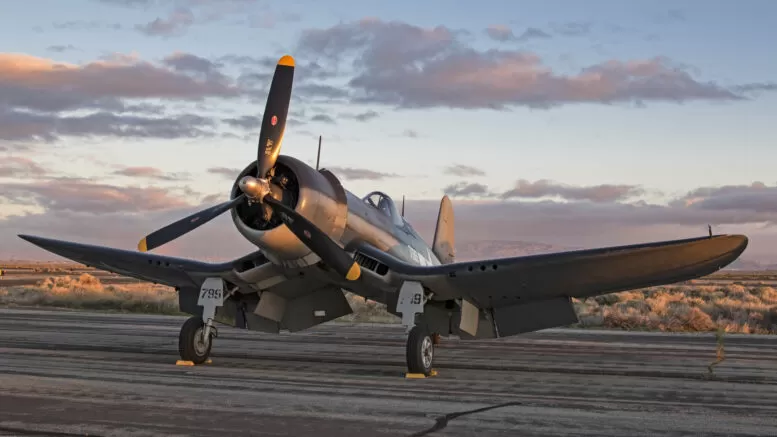
Today, the F4U Corsair remains etched in public memory. With its unmistakable bent wings and deep-blue paint, it is a staple at airshows, museums, and aviation documentaries. The aircraft’s legend is kept alive not only through stories of heroism but also by the haunting nickname it earned from its enemies.
Engineering a Beast: The Design of the F4U Corsair
At first glance, the F4U Corsair’s design is unlike any other fighter of its time, thanks to its distinctive wing design. The inverted gull wing allowed the aircraft to house a massive propeller while maintaining clearance for carrier operations. This design also helped reduce drag and improve stability during high-speed flight.
The heart of the F4U Corsair was its Pratt & Whitney R-2800 Double Wasp engine, producing over 2,000 horsepower. This gave the Corsair unmatched speed and climb rate for its era. In level flight, it could outpace nearly every adversary it encountered, making it a deadly asset in skilled hands.
Despite its promise, the F4U Corsair initially struggled with carrier landings. Its long nose obstructed visibility, and the aircraft tended to bounce upon touchdown. However, refinements in landing technique and aircraft configuration eventually solved these issues, solidifying its reputation as a dependable naval fighter.
Dominance in the Pacific Theater
The F4U Corsair earned its reputation over the waters of the Pacific. Pilots quickly discovered that its firepower, durability, and speed gave them an edge against enemy aircraft like the Mitsubishi A6M Zero. American aviators leveraged this advantage to devastating effect in numerous aerial engagements.
In addition to air-to-air combat, the F4U Corsair proved effective in ground attack missions. It could carry bombs, rockets, and even napalm canisters, striking enemy supply lines, fortifications, and infrastructure with brutal precision. Its versatility made it a cornerstone of U.S. naval air strategy.
Corsair squadrons played a crucial role in securing U.S. dominance during battles such as Okinawa and Iwo Jima. As the war progressed, Japanese forces came to fear and respect the Corsair’s presence overhead.
What Did the Japanese Call the F4U Corsair?
To the Japanese military, the F4U Corsair was a terror in the sky. Japanese pilots and ground forces reportedly referred to it as “Whistling Death,” a nickname rooted in both fear and respect. The sound it produced as it dove or banked overhead became a harbinger of destruction.
This ominous name was not given lightly. The Corsair’s speed, aggressive maneuvering, and heavy armament made it a dominant force. Japanese troops often found themselves outgunned and outpaced, especially in the latter years of the war when Corsairs were deployed in large numbers.
“Whistling Death” speaks to the psychological warfare that accompanies physical conflict. For the enemy, hearing that whistle meant incoming danger. For Allied forces, it was the sound of aerial superiority. The nickname helped solidify the F4U Corsair’s place in military lore, across both sides of the battlefield.
Why Was the Corsair Called Whistling Death?
The F4U Corsair earned its chilling nickname thanks to its unique acoustic signature. As it tore through the sky, air rushing through the wing-root oil coolers and the intake ducts created a distinct, high-pitched whistling sound. To those on the ground, especially enemy troops, this noise became instantly recognizable and dreaded.
Equipped with six .50 caliber machine guns and capable of carrying ordnance beneath its wings, the Corsair made quick work of enemy aircraft and ground targets alike. Its combination of speed and firepower often meant that by the time the whistle was heard, it was already too late.
This eerie sound became part of the aircraft’s legend and reflected how effective the F4U Corsair was at instilling fear and asserting dominance on the battlefield.
Post-War Use and Continued Service
Though World War II eventually ended, the F4U Corsair’s story did not. It saw extensive use during the Korean War, especially in ground support roles. Its rugged design made it well-suited for bombing runs and close air support in the challenging terrain of the Korean Peninsula.
Beyond the United States, several nations adopted the Corsair into their own air forces, including France and New Zealand. It continued flying combat missions well into the 1950s, long after newer jet aircraft entered service.
Eventually, the F4U Corsair was retired from active duty. Yet many were preserved, restored, and displayed. Today, aviation enthusiasts and historians can see these warbirds in flight at airshows or up close in museums, where they serve as living reminders of a remarkable era in military aviation.
The F4U Corsair in Pop Culture and Media
The F4U Corsair has long held a special place in pop culture, appearing in numerous war films, documentaries, and video games that celebrate its wartime service.
From classic TV series like Black Sheep Squadron to realistic flight simulators and historical dramas, the Corsair’s striking silhouette and distinctive gull wings make it instantly recognizable on screen.
The F4U Corsair often serves as a visual gateway into the broader story of World War II aviation. For many viewers, seeing it in action offers a visceral connection to the battles fought decades ago, highlighting the bravery and skill of the pilots who flew it.
See Iconic Planes Like The F4U Corsair at Wings Over Camarillo
For those who have only read about the F4U Corsair, a similar iconic aircraft, Wings Over Camarillo offers a rare opportunity to experience it in person.
Visitors of all ages can learn about different aircraft’s construction, wartime missions, and the brave pilots who flew them. For families, veterans, and history buffs alike, the event creates an immersive learning experience grounded in authenticity and appreciation. Buy tickets to our air show today and get a look at some iconic aircraft.
Conclusion
The F4U Corsair has a legacy forged in battle, innovation, and resilience. From the flight decks of aircraft carriers to the skies over the Pacific, it proved itself time and again as a force to be reckoned with.
Its nickname, “Whistling Death,” still sends a chill down the spine of those who know its story. That sound, that silhouette, and that spirit remain part of its enduring mystique.
As generations continue to honor the past, the F4U Corsair will never fade into obscurity. Whether in flight at an airshow or on display, it continues to inspire, educate, and remind us of the courage that shaped history.
Ready to Soar with Us?