
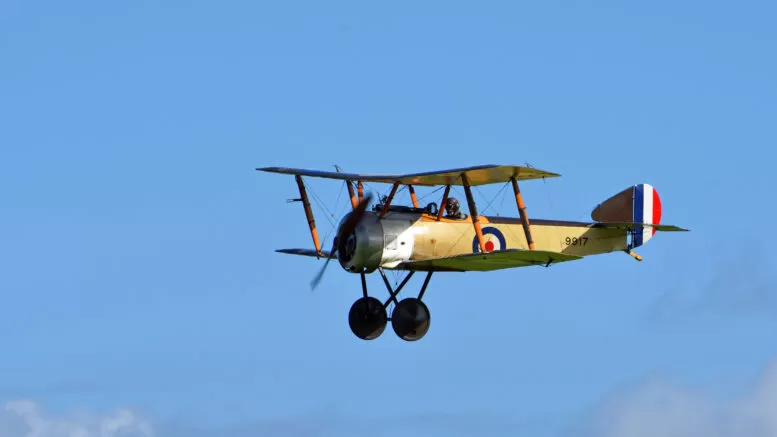
During WWI, aviation quickly evolved from simple flights to see what the enemy was doing to intense aerial combat. The Sopwith Camel became one of the era’s most famous fighter planes thanks to its speed and agility, though it was challenging to operate. Still, skilled pilots could successfully dominate mid-air dogfights. This aircraft helped shape modern air combat and has left a lasting legacy in aviation history.
In the early days of air combat, it’s easy to assume that aircraft would have been made to be simple, gentle, and slow. After all, the world of aviation was just beginning to embrace its capabilities as World War I broke out. It was during this time that pilots proved how courageous they were and how capable their aircraft, such as the Sopwith Camel, were. Very few planes represent this era more dramatically than this one.
Come with us as we explore this iconic WWI fighter plane more closely, as you get to know and appreciate the Sopwith Camel as much as we do.
A Fighter Plane Born in War
The Camel’s maiden flight was during the height of World War I. It was built by the British at the Sopwith Aviation Company to fulfill a dominant role in the rapidly evolving battlefield in the sky.
Aerial warfare was fairly new during this time. Previously, most aircraft were used for reconnaissance and staying on top of what the enemy was doing. But as the war progressed, it wasn’t long before both sides began taking the war to new heights by creating fighter planes.
This is when the Sopwith Camel proved itself as more than capable of controlling the skies. And its performance during WWI is what made it legendary.
What’s In a Name?
What kind of name is Sopwith Camel? If you have never seen one, then this question has probably crossed your mind. And if you have, well, you’ll be able to imagine just what we are going to tell you.
The aircraft was built with a very distinctive hump over the twin machine guns that are mounted in front of the cockpit. This intentional design was to protect the guns. What it did, however, was give the plane an unmistakable camel-like profile.
Its appearance was almost as memorable as its performance.
Power, Agility, and Specifications
A rotary engine powered the Sopwith Camel. That means it had an engine that spun along with the propeller to create a powerful gyroscopic effect that influenced how the aircraft handled. In other words, when the pilot tried to turn, the engine resisted and would force the aircraft’s nose to rise in left turns and dive in right turns.
Experienced pilots found all of this to be a bonus. Why? Because it allowed the aircraft to turn exceptionally fast. It was this maneuverability that made the difference between victory and defeat in aerial battles.
As for specifications, the plane had a top speed of about 115 mph and a ceiling of about 19,000 feet. And with the twin synchronized .303 Vickers machine guns, it was quite the weapon in the sky.
Skill Was Demanded
It is no secret that you had to be a highly skilled pilot to control the Camel. The weight of the engine, fuel, pilot, and guns was all housed in the front several feet of the aircraft. This had a significant impact on how the plane was handled.
Due to this instability, many inexperienced pilots lost control of the aircraft, especially during takeoff and landing. It is even rumored that more Camel pilots were lost in training accidents than in combat. But when that aircraft was put in the hands of a skilled aviator, it became one of the most dangerous fighter planes of WWI.
The Evolution of Aerial Combat
During the war, the Camel was credited with shooting down over 1,200 enemy aircraft. And nighttime operations were popular, commonly used to intercept German bombers that made threats across Britain. It was pushed to its limits, with some of history’s best pilots commanding this aircraft. In doing so, they were able to make their tight turning ability an asset during mid-air dogfights, outmaneuvering many enemy planes.
Before the war started, there was still a lot of experimentation going on in aviation. But as the demand for fighters increased, so did the rapid innovation in aircraft design, weapons, and tactics. Not only were planes being designed for these missions, but pilots began developing aerial combat techniques that are still studied today.
It was, by far, one of the most successful fighter aircraft ever deployed in WWI.
The Sopwith Camel: An Aviation Icon
While the airplane made its debut during a shaky time in history, it remained a symbol of early aviation long after the war ended. It has appeared in history books, aviation museums, documentaries, and pop culture.
For enthusiasts, the Sopwith Camel represents more than just another aircraft. It represents a time when aviation was still young, pilots were fearless pioneers, and every flight pushed the boundaries of what was possible. Its innovative design, combined with the courage of skilled aviators, left a mark on history.
Today, there are surviving Camels, though very few are found in the air. Restored originals or replicas can often be found at airshows and museums around the world. This upclose look not only links you with an important part of history, but it also helps you to get a better idea of what flying one of these aircraft may have felt like.
Dive Into Aviation History at Wings Over Camarillo
The story of this iconic WWI fighter jet is a reminder that aviation history is what shaped the skies we know today. The Sopwith Camel had a legendary combat record and unmatched agility that made it one of the most exciting aircraft of all time.
That same spirit of exploration and innovation is still alive today, shaping aviation communities. So, if you love learning about the legends and want to connect with others who share the same passion for flight, we invite you to the Wings Over Camarillo Air Show. Save the date: August 15th and 16th, 2026.
Don’t miss out on this opportunity.
Ready to Soar with Us?