
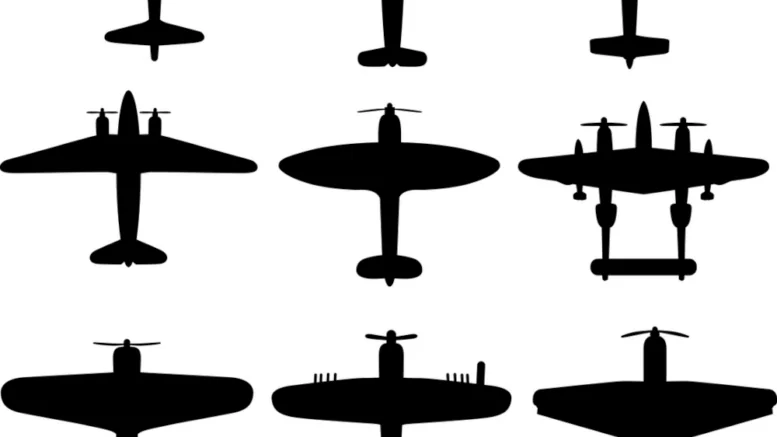
The roar of a Merlin engine, the distinct silhouette of an elliptical wing, and the sheer speed of a metal bird diving from the clouds—these are the hallmarks of a conflict that was decided as much in the air as it was on the ground. During the 1940s, aviation technology underwent a decade of advancement that would normally take half a century. The result was a collection of WWII fighter planes that became symbols of national resolve and engineering brilliance.
From the Battle of Britain to the vast expanses of the Pacific Theater, air superiority was the ultimate prize. To understand the history of the 20th century, one must understand the machines that claimed the heavens. Here is a deep dive into the legendary aircraft that dominated the skies.
The North American P-51 Mustang: The “Cadillac of the Skies”
No list of World War II fighter planes is complete without the P-51 Mustang. Originally designed to fulfill a British requirement, the Mustang was a good plane that became a legendary one when engineers made a pivotal decision: they swapped its original Allison engine for the British-designed Rolls-Royce Merlin.
This marriage of American airframe design and British engine power created a long-range escort fighter that could accompany Allied bombers all the way to Berlin and back. Before the Mustang, bombers were often left defenseless once they outpaced their short-range escorts, leading to devastating losses.
The Statistic of Dominance
The P-51 Mustang was so effective that by the end of the war, it was credited with destroying 4,950 enemy aircraft in the air, the highest total for any Allied fighter in the European theater.
The Supermarine Spitfire: The Savior of Britain
If the Mustang was the sword of the Allied air campaign, the Supermarine Spitfire was the shield. With its iconic elliptical wings and thin cross-section, the Spitfire was designed for high-performance interceptions.
During the Battle of Britain in 1940, the Spitfire worked in tandem with the Hawker Hurricane. While the Hurricane focused on taking down the slow-moving German bombers, the Spitfire engaged the Messerschmitt Bf 109s. Its superior maneuverability and climbing rate allowed British pilots to hold their own against the Luftwaffe’s best. The Spitfire remained in production throughout the entire war, undergoing dozens of “Marks” or iterations to stay ahead of evolving German technology.
The Messerschmitt Bf 109: The Backbone of the Luftwaffe
For much of the war, the Messerschmitt Bf 109 was the primary adversary of Allied pilots. It was a masterpiece of “lightweight” design, built around the most powerful engine available at the time. It featured a fuel-injected engine, which gave it a massive advantage over the early Spitfires; the Bf 109 could dive vertically without the engine cutting out, whereas the Spitfire’s carbureted engine would often stall under negative G-forces.
The Bf 109 was flown by the highest-scoring aces in history. However, its narrow landing gear made it notoriously difficult to land, and its limited fuel capacity meant it couldn’t stay over England for more than 10 to 20 minutes during the Battle of Britain—a flaw that eventually contributed to the German defeat in that campaign.
The Mitsubishi A6M Zero: The Ghost of the Pacific
In the early years of the war in the Pacific, the Mitsubishi A6M “Zero” was a name that inspired fear. It was incredibly light, lacked armor plating, and didn’t have self-sealing fuel tanks. While this made the plane fragile, it also gave it an unprecedented range and a turning radius that no Allied plane could match.
In 1941 and 1942, Allied pilots were strictly warned: Do not dogfight a Zero. If a pilot tried to out-turn a Zero, they would lose every time. It wasn’t until the arrival of heavier, more powerful American planes like the F6F Hellcat—and the development of “boom and zoom” tactics—that the Zero’s dominance was finally broken.
The Vought F4U Corsair: The “Whistling Death”
Easily recognizable by its unique inverted gull-wing design, the F4U Corsair was built for power. The “bent” wings were necessary to provide enough ground clearance for its massive three-blade propeller while keeping the landing gear legs short and sturdy for carrier landings.
Though it had a rocky start as a carrier-based aircraft due to visibility issues, it became a favorite of the U.S. Marine Corps operating from island airstrips. It was fast, rugged, and packed a massive punch with six .50 caliber machine guns. Japanese pilots nicknamed it “Whistling Death” because of the sound the air made as it passed through the wing-root oil coolers during high-speed dives.
The Focke-Wulf Fw 190: The “Butcher Bird”
When the Focke-Wulf Fw 190 first appeared over France in 1941, it sent shockwaves through the Royal Air Force. It was superior to the Spitfire V in almost every aspect except for turning radius. Unlike the liquid-cooled Bf 109, the Fw 190 used a BMW radial engine, making it incredibly tough; it could sustain significant damage and keep flying.
The Fw 190 was a versatile “workhorse,” serving as a day fighter, fighter-bomber, and ground-attack aircraft. Its wide-track landing gear made it much safer to operate from rugged frontline airfields than the Bf 109.
The Lockheed P-38 Lightning: The Fork-Tailed Devil
The P-38 Lightning was one of the most distinctive WWII fighter planes due to its twin-engine, twin-boom design. This configuration allowed it to carry a massive amount of concentrated firepower in the nose—unlike other fighters whose guns were mounted in the wings and required “harmonization” to converge at a certain distance.
In the Pacific, the P-38 became the mount of choice for America’s top two aces, Richard Bong and Thomas McGuire. Its twin engines provided an extra layer of safety when flying hundreds of miles over open ocean; if one engine failed or was shot out, the pilot could still limp home on the other.
The Evolution of Aerial Combat
The transition from the biplanes of the 1930s to the jet-powered Me 262 at the end of the war represents the most rapid period of technological growth in human history. These World War II fighter planes were not just machines; they were the pinnacle of physics and industrial capability.
Pilots of these aircraft had to be more than just “drivers.” They had to be mathematicians, engineers, and marksmen. They operated in unpressurized cabins, often at altitudes where oxygen was scarce and temperatures dropped to 40 degrees below zero.
Preserving the Legacy
Today, seeing these aircraft in person is a rare and moving experience. They serve as “living” museums, reminding us of the sacrifices made by the Greatest Generation. At events like Wings Over Camarillo, history comes off the pages of textbooks and takes to the sky. Hearing the thunder of these vintage engines is a visceral reminder of the bravery required to strap into a cockpit and head into the unknown. Be sure to attend the next airshow where you can see real WWII airplanes.
Whether it’s the sleek lines of the Mustang or the rugged roar of the Corsair, these aircraft continue to dominate our imaginations just as they once dominated the skies. They are a testament to human ingenuity and a permanent tribute to those who flew them into history.
Ready to Soar with Us?