
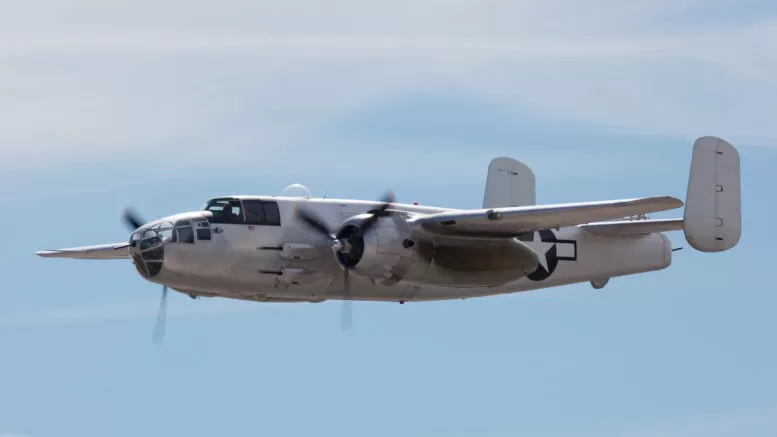
Designed to meet the urgent demand for a fast, medium-range bomber, the B-25 quickly became one of the most respected and relied-upon aircraft in the Allied arsenal during World War II. From the skies over Europe to the vast Pacific theater, it proved to be a workhorse capable of adapting to the dynamic and often unpredictable nature of wartime missions.
More than 80 years after its first flight, the B-25 Mitchell continues to capture the imagination of aviation enthusiasts and historians alike. Restored and maintained by dedicated crews, these aircraft still take to the skies at airshows across the country.
Why Is the B-25 Called the Mitchell?
The B-25 Mitchell owes its name to one of the most influential and controversial figures in early American military aviation, Brigadier General William “Billy” Mitchell. A fierce advocate for air power during a time when many military leaders still saw aviation as secondary to naval and ground forces. His outspoken beliefs, although met with resistance and ultimately leading to a court-martial, laid the groundwork for the development of a modern, independent air force.
Mitchell’s influence began during World War I, when he commanded American air units in France and saw firsthand the strategic potential of aircraft. After the war, he became a relentless proponent of expanding and investing in military aviation. When North American Aviation developed the B-25, the U.S. Army Air Forces named it in honor of Mitchell’s unwavering commitment to air power.
Engineering Excellence — Inside the B-25 Mitchell
The B-25 Mitchell was an engineering achievement that combined power, adaptability, and intelligent design. Developed by North American Aviation, this twin-engine medium bomber was created to fill the gap between light attack aircraft and heavy bombers. Its performance specifications struck a balance that made it ideal for a wide variety of missions across multiple theaters of war.
At its peak, the B-25 Mitchell could reach speeds of around 275 miles per hour and had a combat range of over 1,300 miles, depending on the mission profile. It was powered by two Wright R-2600 Cyclone radial engines, each delivering approximately 1,700 horsepower. With a standard bomb load of 3,000 pounds and the capacity to carry even more when needed, the B-25 offered considerable firepower. It was also heavily armed with multiple .50 caliber machine guns, giving it a solid defense against enemy aircraft.
Iconic Missions and Wartime Service (Expanded)
Among the many missions flown by the B-25 Mitchell, one of the most iconic is the Doolittle Raid. On April 18, 1942, just months after the attack on Pearl Harbor, sixteen B-25s launched from the deck of the USS Hornet in a daring strike against Tokyo and other Japanese cities. This was a feat previously thought impossible, since launching medium bombers from an aircraft carrier was unprecedented.
Beyond this historic moment, the B-25 Mitchell went on to become one of the most widely deployed and battle-proven bombers of World War II. In Europe, the aircraft served with the U.S. Army Air Forces and various Allied air arms, flying medium-altitude bombing runs against German railroads, bridges, and industrial centers. Crews favored the B-25 for its handling characteristics and ability to absorb damage; many limped back to base full of flak holes and still managed safe landings.
In North Africa, the Mitchell’s rugged build and low-level attack capabilities made it ideal for desert warfare, where quick-strike bombing and strafing runs helped soften enemy positions ahead of Allied advances.
In the Pacific Theater, the B-25 truly showcased its adaptability. Modified versions with solid noses packed with forward-firing machine guns became lethal tools for low-level attack missions. One of the B-25’s most effective roles here was skip bombing, a tactic that involved flying low over water and releasing bombs that would “skip” into enemy ships, much like a stone skipping across a pond. This method proved devastating against Japanese convoys and was a key tactic in the island-hopping campaign.
Meanwhile, in Southeast Asia, B-25s operated in challenging environments, flying through monsoons, mountains, and jungles to disrupt enemy supply lines across Burma and into China. Reconnaissance missions, supply drops, and close air support became part of its daily routine in a region where airfields were often primitive and enemy defenses relentless.
Is the B-25 Mitchell Still Flying?
Remarkably, more than eight decades after its first flight, the B-25 Mitchell continues to grace the skies. While thousands were produced during World War II, only a limited number have survived into the modern era. Today, approximately 40 to 50 B-25s remain airworthy, with others preserved as static displays in museums around the world. These surviving aircraft serve as a living tribute to the engineering excellence and historical significance of the B-25.
Many B-25s have been painstakingly restored to their original combat configurations, right down to period-authentic paint schemes and nose art. These efforts ensure that new generations can experience the aircraft not just as museum pieces, but as vibrant, flying chapters of history. For those eager to witness the B-25 Mitchell in flight, airshows across the country offer unforgettable opportunities. Events like Wings Over Camarillo bring these historic military planes back to life, allowing visitors to see, hear, and feel the power of the B-25 as it roars overhead.
Discover Iconic Aircraft like the B-25 Mitchell at Wings Over Camarillo
For aviation enthusiasts and history buffs alike, Wings Over Camarillo offers an unforgettable opportunity to see legendary aircraft like the B-25 Mitchell in action. Held annually in Camarillo, California, our airshow brings together a remarkable collection of flying warbirds, static displays, and immersive experiences.
Attendees will find other historic aircraft, classic cars, and even a chance to book rides in vintage planes. Wings Over Camarillo honors the legacy of flight, offering a rare glimpse into the machines and missions that helped define the modern era. Get your tickets today.
Conclusion
From the daring Doolittle Raid to its many missions across Europe, the Pacific, and beyond, the B-25 Mitchell played a crucial role in the Allied victory during World War II. Its balanced design, strategic versatility, and enduring reliability earned it the admiration of the pilots and crews who trusted it with their lives.
Decades later, the B-25 continues to fly, not as a weapon, but as a living tribute to the past. Through restoration efforts and public events like Wings Over Camarillo, new generations are given the chance to connect with aviation history in a way that books and documentaries simply cannot match.
Ready to Soar with Us?