
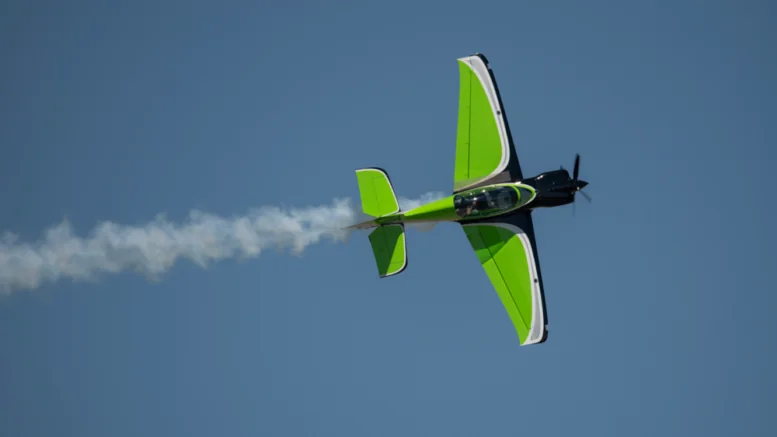
When you stand on the tarmac at an airshow, squinting against the bright sun, the sound usually reaches you before the sight does. It is a high-pitched, angry snarl—the sound of an engine pushed to its absolute mechanical limits. Then, you see it: a flash of color streaking vertically toward the clouds. It doesn’t just fly; it dances. This is the world of aerobatic planes, where the laws of physics are treated more like suggestions and the sky serves as a massive, three-dimensional canvas.
Aerobatics is often called “sky art,” but it is an art form rooted in brutal physical reality and precision engineering. Unlike standard aircraft designed to transport passengers comfortably from point A to point B, an aerobatic plane is built for a singular, grueling purpose: to remain controllable and structurally sound while moving in ways that would tear a conventional airplane apart. To understand these masters of stunts, we must look at the evolution of the airframes, the physics of the maneuvers, and the incredible pilots who command them.
The Engineering of Extreme Agility
What exactly separates aerobatic planes from the Cessnas or Pipers you see at your local airfield? The answer lies in the structural load limits, known as “G-limits”. While a standard general aviation aircraft might be rated for a maximum of 3.8 positive Gs (meaning the airframe can support 3.8 times its own weight), a top-tier competition aerobatic plane like the Extra 330SC or the Zivko Edge 540 is built to withstand staggering forces of +/- 10 Gs.
Stunt Statistic
Modern competition aerobatic aircraft can achieve roll rates of over 400 degrees per second, allowing a pilot to complete a full 360-degree roll in less than one second.
To achieve this, engineers utilize advanced materials. High-strength steel tubing forms the fuselage “cage,” while wings are often constructed from carbon fiber composites that offer a strength-to-weight ratio far superior to aluminum. Weight is the enemy of performance. Every unnecessary ounce is stripped away, leaving a cockpit that is often cramped and utilitarian, designed solely to keep the pilot strapped securely in place during violent tumbles.
Furthermore, the wings of an aerobatic plane are unique. Most airplanes use an asymmetrical airfoil—a wing that is curved on top and flatter on the bottom—to generate lift efficiently for level flight. Aerobatic wings, however, are often symmetrical. This means the plane generates lift just as effectively whether it is right-side up or upside down. While this makes the plane “twitchy” and harder to fly in a straight line, it is the secret ingredient that allows for seamless transitions between upright and inverted maneuvers.
The Engines: Hearts of Fire and Oil
Gravity is a constant adversary in the sky. To perform vertical climbs that seem to last forever, an aerobatic plane requires a massive power-to-weight ratio. These aircraft are typically powered by high-output, fuel-injected piston engines, such as the Lycoming AEIO-540. The “I” in the engine designation stands for fuel injection, and the “O” for horizontally opposed, but the most important part of the aerobatic engine is the “A”—meaning it is rated for aerobatics.
In a normal aircraft, gravity keeps the oil at the bottom of the engine and the fuel at the bottom of the tank. If you flip a standard plane upside down, the engine will quickly starve and seize. Aerobatic engines utilize specialized “inverted oil systems” (often called Christen systems). These use a series of valves and a secondary oil sump to ensure that no matter the orientation—sideways, vertical, or upside down—lubricating oil continues to reach the moving parts and fuel continues to reach the cylinders. Without this technology, the modern airshow routine would be impossible.
Defining the Maneuvers: The Language of Stunts
When you watch aerobatic planes at Wings Over Camarillo, you aren’t just seeing random flailing. You are seeing a choreographed sequence of “figures” from the Aresti Catalog—the universal shorthand for aerobatic competition. These maneuvers can be broken down into several categories:
The Precision Lines
This is the foundation of sky art. It involves drawing perfectly straight vertical, horizontal, and 45-degree lines in the sky. The difficulty lies in the wind; a pilot must crab the aircraft slightly to ensure the “trace” left in the sky looks straight to the judges and the audience below.
Rotational Maneuvers
These include rolls, loops, and spins. A “Slow Roll” is particularly difficult, as the pilot must continuously adjust the rudder and elevators to maintain a perfectly straight altitude as the plane rotates 360 degrees. A “Snap Roll,” by contrast, is a violent, high-speed maneuver where the pilot purposefully stalls one wing to make the plane “snap” around its axis.
Gyroscopic Tumbles
This is where the aerobatic plane begins to look like it is malfunctioning. By using the massive torque of the propeller at low airspeeds, pilots can perform “Lomcovaks” or “Power Addled Tumbles”. The airplane appears to flip end-over-end, seemingly out of control, before the pilot recovers with surgical precision.
The Human Element: Pilots as Athletes
We cannot talk about aerobatic planes without discussing the athletes in the cockpit. Flying aerobatics is physically punishing. When a pilot pulls 8 or 9 Gs, the blood in their body is forced toward their feet. To prevent “G-LOC” (G-induced Loss Of Consciousness), pilots must use a specialized “Hick maneuver”—a combination of muscle tensing and rhythmic breathing—to keep oxygenated blood in the brain. Conversely, “Negative Gs” push blood toward the head, leading to a “Red-out,” which can burst small capillaries in the eyes.
The mental load is equally high. A pilot must maintain perfect situational awareness while spinning at 400 degrees per second, all while keeping a safe “floor” altitude. It is a discipline that requires thousands of hours of training. At a show like Wings Over Camarillo, you are seeing the result of a lifetime of dedication to the craft.
Why Aerobatics Captivates Us
Ultimately, aerobatic planes represent the pinnacle of human daring. They take a technology originally designed for utility and weaponized for war and turn it into a form of pure, joyous expression. When an aerobatic plane leaves a trail of white smoke behind it, it is literally drawing on the sky, showing us that with enough courage and engineering, we can transcend our earthbound nature.
Whether it is a vintage biplane performing a graceful barnstorming routine or a modern carbon-fiber beast doing things that seem to break the laws of physics, these aircraft remind us why we fell in love with flight in the first place. They are the masters of the sky, turning every airshow into a breathtaking gallery of sky art. Check out our next airshow!
Ready to Soar with Us?