
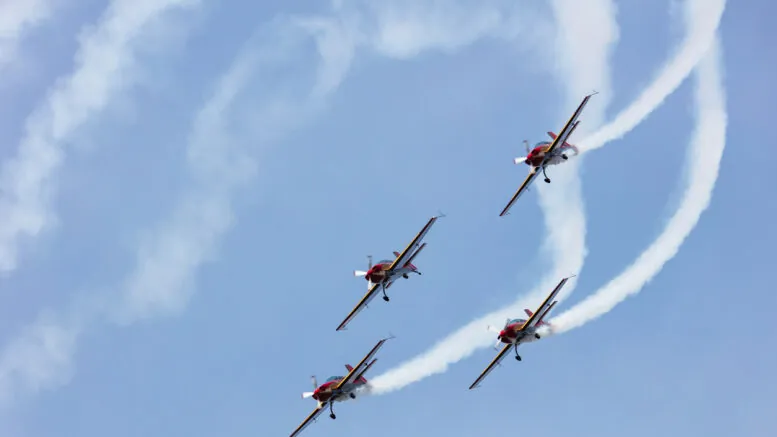
There is a distinct moment during an airshow when the background chatter of the crowd entirely fades away. It usually happens just as a roar of radial engines or the crisp whine of modern turboprops cuts through the air. You look up and see a localized grid of aircraft, locked together so tightly they appear to be welded by an invisible frame. They move across the sky not as individual machines, but as a singular, undulating organism.
This is the art of formation flying. To the spectator on the ground at events like the Wings Over Camarillo airshow, it looks like magic. In reality, it is a hyper-disciplined mixture of aerodynamic physics, relentless training, absolute trust, and deeply rooted military history.
To understand how these pilots achieve such mesmerizing precision, we have to look past the smoke trails and dive into the mechanics, the mental toll, and the tactical evolution that brought this discipline from the battlefields of World War I to the modern civilian airshow circuit.
The Crucial Physics: Why the Sky Is a Moving Target
To understand the sheer difficulty of maintaining a tight formation, you have to discard the idea that air is empty space. To a pilot, air is a fluid dynamic medium fluid like water, but highly volatile. When an airplane cuts through the sky, it creates massive disturbances in its wake, including wingtip vortices, wash, and localized low-pressure zones.
When a wing generates lift, high-pressure air from underneath rolls over to the low-pressure zone on top, creating a swirling vortex off the wingtip. If a wingman flies just a few feet out of position, their aircraft can be caught in this “prop wash” or wake turbulence. The violent, unpredicted roll can instantly disrupt the shape of the flight or, in worst-case scenarios, cause mid-air contact.
The Aerodynamic Benefit
Paradoxically, flying in a precise formation can also provide an aerodynamic advantage if done correctly. Much like migratory birds flying in a V-formation, aircraft can harvest the upwash generated by the plane ahead of them. Studies by aeronautical engineers have demonstrated that flying in a strategic V-formation can reduce fuel consumption by up to 15% for the trailing aircraft due to the reduced drag experienced in the sweet spot of the lead plane’s vortex.
However, in the dynamic environment of an airshow, airshow performance and presentation override fuel economy. Pilots actively combat these fluid air currents through minute, continuous micro-adjustments to their stick, rudder, and throttle.
A Timeline of Tactical Evolution
What began as a desperate necessity for survival in the skies over Europe eventually transformed into the disciplined choreography seen at modern aviation events. The history of flying in close proximity traces a clear line through major global conflicts.
Inside the Cockpit: The Mechanics of Communication and Sight
How do pilots stay perfectly aligned while flying at hundreds of miles per hour, sometimes with less than three feet of separation between their wingtips? The answer lies in a rigid hierarchy of sightlines and non-verbal cues.
          [ Flight Lead ]
         /               \
   (Wingman 2)       (Wingman 3)
       /                   \
 (Slot Pilot)         (Wingman 4)
The Flight Lead Is the Only One Looking Ahead
In a formation flight, the Flight Lead is the brains of the operation. The leader is the only pilot looking at the horizon, navigating the airspace, managing energy levels, and planning the next maneuver. The leader must fly with exceptional smoothness, making predictable, anticipated inputs. If the leader jerks the controls, the entire formation ripples dangerously.
The Wingmen Fly the “Line”
Wingmen do not look at the horizon. They do not look at the crowd, and they rarely look at their instrument panel. Instead, their eyes are locked completely onto a highly specific part of the Lead’s aircraft.
Pilots use visual alignment marks, often called “sight lines.” For example, a wingman might position their cockpit so that the trailing edge of the Lead’s wing aligns perfectly with a specific rivet or paint line on the fuselage. If that rivet moves even an inch out of alignment in their canopy window, the wingman instantly adjusts their controls to correct the gap.
Vocal Subtleties in the Radio Cadence
While hand signals are used in quiet transit, airshow maneuvers require vocal cues. The Flight Lead uses a distinct, rhythmic cadence over the radio to signal a change in pitch, roll, or power.
Instead of a sudden command, a leader might drawl: “Turning left… three, two, one… roll.” The melodic, predictable structure of the speech allows wingmen to anticipate the physical movement of the lead plane and move their own controls simultaneously, eliminating human reaction delay.
Classic Airshow Formations Every Fan Should Know
When teams take to the sky at Camarillo, they loop, roll, and reposition through several standardized geometries. Recognizing these profiles enhances the viewing experience significantly.
The Diamond
A classic four-ship setup. The Lead is at the front, Wingmen 2 and 3 are tucked tightly to the left and right sides, and the “Slot” pilot flies directly behind and slightly below the leader’s wake.
The Echelon
All aircraft are stepped out to one side of the leader, forming a diagonal line like a staircase in the sky. This is incredibly difficult for the outer pilots, as they must adjust to the compounded movements of every plane inside them.
The Trail
Aircraft fly in a single straight line, one directly behind the other. This configuration is frequently used to transition into high-speed solo breaks or vertical climbs.
The Missing Man
A poignant, solemn formation used to honor fallen aviators. Typically, a four-ship V or diamond flies over the crowd, and one aircraft suddenly pulls up out of the group, climbing into the sun to symbolize a soul leaving Earth, while the remaining planes hold their positions.
The Human Factor: The High Price of Precision
The physical and psychological toll of flying close-proximity aerobatics is immense. Because wingmen must maintain unbroken focus on their visual reference points, spatial disorientation is a constant threat. The human inner ear can easily play tricks when an aircraft is banking hard without a visible horizon to anchor the pilot’s brain. Pilots must train themselves to ignore their physical instincts and trust their visual alignment explicitly.
Furthermore, high-G maneuvers drain physical energy quickly. Pulling a tight turn in formation means struggling against gravitational forces that make the human body feel multiple times heavier than normal, all while executing the microscopic muscle movements required to keep a multi-ton aircraft inches away from its neighbor. It requires peak physical conditioning and a level of mental endurance that few civilian activities can match.
Preserving the Heritage at Wings Over Camarillo
At its core, showcasing these flight profiles is about keeping a vital piece of living history alive. Seeing historic warbirds, like the P-51 Mustangs, F8F Bearcats, and PBJ Mitchell bombers of the Commemorative Air Force fly in synchronized patterns provides a sensory link to the past that no textbook or museum display can replicate.
When you watch these aircraft interlock their flight paths over Ventura County, you aren’t just watching a performance. You are witnessing a masterclass in aerodynamics and human capability a discipline forged in combat, refined over a century, and executed by volunteers dedicated to preserving the golden age of aviation. Check out an air show near you to see for yourself the formation flying that can be achieved today!
Ready to Soar with Us?