
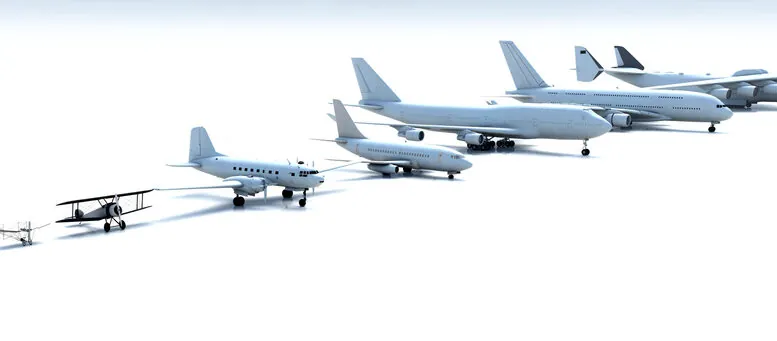
Humanity has always looked at the sky with a sense of wonder. For thousands of years, the idea of soaring above the clouds was reserved for myths and legends. That changed forever in December 1903 when the Wright brothers achieved the first powered, controlled flight in Kitty Hawk, North Carolina.
While that monumental achievement proved that humans could fly, it did not immediately establish a practical way for ordinary people to travel. It took another decade of rapid engineering and daring experimentation before the idea of a passenger airline became reality.
To trace this journey back to its roots, we must ask a fundamental question: When Did Commercial Air Travel Start?
The answer takes us to a sunny bay in Florida at the very beginning of 1914. It is a story of a single passenger, a wooden flying boat, and a vision that changed the world.
The Historic First Flight: January 1, 1914
The birth of commercial air travel occurred on January 1, 1914, across Tampa Bay, Florida. On that morning, a crowd of over 3,000 spectators gathered in St. Petersburg to witness the launch of the St. Petersburg-Tampa Airboat Line.
The airline was the brainchild of Percival Fansler, an electrical engineer who saw a business opportunity in connecting the two cities. At the time, traveling between St. Petersburg and Tampa was a grueling journey. A trip took up to twelve hours by train, three hours by boat, or a full day by automobile.
Fansler proposed a revolutionary solution. By flying across the water, the travel time could be cut to less than 25 minutes.
To execute his vision, Fansler partnered with aircraft builder Thomas Benoist and a skilled pilot named Tony Jannus. The aircraft selected for the journey was a Benoist Type XIV, an open-cockpit wooden flying boat that could seat just one pilot and one passenger.
The very first passenger ticket was sold at a public auction. Abram C. Pheil, the former mayor of St. Petersburg, won the seat with a winning bid of 400 dollars. This is roughly equivalent to nearly 10,000 dollars today.
At 10:00 AM, Jannus throttled the 75-horsepower engine, and the aircraft skimmed across the water before rising into the air. Flying barely 5 feet to 50 feet above the waves, Jannus guided the plane across the 23-mile stretch of water.
The flight took exactly 23 minutes to complete, marking the official beginning of scheduled commercial aviation.
The Impact of the St. Petersburg-Tampa Airboat Line
The St. Petersburg-Tampa Airboat Line operated twice daily, six days a week, for three months. Regular one-way tickets were priced at a much more reasonable 5 dollars, which was still a luxury expense for most working Americans at the time.
During its brief three-month run under its initial contract, the airline completed 172 flights and carried 1,205 passengers across more than 7,000 miles. It also carried freight, including bundles of the local newspaper.
While the airline eventually ceased operations when the winter tourist season ended, it proved to the world that commercial flight was not only possible but highly practical.
You can learn more about historic aircraft and witness the majesty of vintage flight up close at the Wings Over Camarillo Air Show. This annual event celebrates the incredible progression of flight technology, from those fragile wooden airboats to the powerhouse machines of the mid-century and beyond.
World War I and the Birth of Airmail
The onset of World War I in late 1914 temporarily shifted global focus away from commercial travel and toward military aviation. Governments poured massive resources into developing faster, stronger, and more reliable aircraft.
By the time the war ended in 1918, thousands of surplus military planes were available, and a generation of highly trained pilots was looking for work. This combination paved the way for the next phase of commercial flight.
In the United States, commercial flight did not actually start with passengers. It started with mail.
The U.S. Post Office Department launched its airmail service in 1918. In 1925, the U.S. Congress passed the Kelly Act, which allowed the government to contract private aviation companies to carry mail.
These early mail contracts provided the stable revenue that private airlines needed to survive. Companies like Boeing, Douglas, and Ford began building larger aircraft designed to carry both mail and passengers, setting the stage for modern airline networks.
The Golden Age of Aviation
By the 1930s, air travel was becoming more sophisticated. The introduction of the Douglas DC-3 in 1936 revolutionized the industry.
The DC-3 was fast, reliable, and comfortable. More importantly, it was the first airplane that could make a profit solely by carrying passengers, freeing airlines from their heavy reliance on government mail subsidies.
Following World War II, aviation technology leaped forward again. Pressurized cabins allowed planes to fly at higher altitudes, above turbulent weather systems.
The true transformation arrived in the 1950s with the introduction of commercial jet engines. The British de Havilland Comet and the American Boeing 707 slashed travel times in half.
Crossing the Atlantic Ocean went from a lengthy sea voyage to a comfortable flight of less than eight hours. This era became known as the Golden Age of Travel, characterized by luxury service, spacious cabins, and a new sense of global connectivity.
Modern Commercial Aviation by the Numbers
Today, commercial aviation is a massive global network that keeps our modern world moving. To understand just how far we have come since Tony Jannus flew his single passenger across Tampa Bay in 1914, we only need to look at the numbers.
According to industry data, commercial airlines carry more than 4.5 billion passengers worldwide every single year.
Additionally, tens of millions of tons of cargo are shipped by air annually. This speed ensures that goods can reach almost any destination on the globe in less than 48 hours.
Preserving the Legacy of Flight
Looking back at the timeline of commercial flight, we can appreciate the immense bravery of the early pilots and passengers. They climbed into open-cockpit planes made of wood and fabric to pave the way for our modern skyways.
At Wings Over Camarillo, our mission is to keep this history alive. We believe that seeing these historic aircraft in action is the best way to understand the evolution of flight.
Whether you are fascinated by WWII fighter planes, classic transport aircraft, or modern aerobatic maneuvers, our annual show offers something for every aviation enthusiast.
If you want to experience the sights and sounds of historic aviation firsthand, we invite you to explore our aircraft archives to learn more about the incredible planes that will be performing.
Join Us at the Next Wings Over Camarillo Air Show
Are you ready to see history take flight? The annual Wings Over Camarillo Air Show brings vintage military warbirds, thrilling aerobatic performances, and classic automotive displays together for an unforgettable weekend.
Do not miss your chance to hear the roar of classic engines and see rare aircraft fly right before your eyes.
Check out our air show schedule and get air show tickets early to secure the best seats for the whole family.
Learn about our volunteer opportunities if you want to get involved behind the scenes.
Bring the kids to explore our interactive STEM Pavilion and inspire the next generation of aerospace engineers.
We look forward to celebrating the rich history and exciting future of aviation with you. See you at the airfield!
Ready to Soar with Us?